Since 1980, Shraddhavan has been teaching English in Auroville through close readings of Sri Aurobindo’s revelatory epic Savitri: a legend and a symbol. In August 1998 these classes were resumed at Savitri Bhavan, with a growing number of students, including young Tamil teacher-trainees from the Arul Vazhi School located in Promesse, Auroville. These classes were given the name ‘The English of Savitri’ and they concluded in May of 2009 as this group reached the end of the poem.
This book is based on the transcripts of a new series of classes given by Shraddhavan between August 2009 and October 2010, which have been edited for conciseness and clarity, while aiming to preserve some of the informal atmosphere of the course. Edited transcripts of these classes began to be published serially in the Bhavan’s journal of Study Notes on Savitri, ‘Invocation’, from issue 32 onwards, since it was felt that they may be of interest to a wider audiance. They are now being published in book form in several volumes by Yukta Prakashan publishers of Vadodara. This suggested the idea of collecting the original English articles into a book form as well. This is the first such volume, covering all the five cantos of Book One of the poem, ‘The Book of Beginnings’.
https://auro-ebooks.com/wp-content/uploads/2015/04/The-English-of-Savitri-cover250sq.png250250Auro e-Bookshttp://auro-ebooks.com/wp-content/uploads/2023/06/auro-ebooks-logo.pngAuro e-Books2015-04-08 11:39:502026-08-26 03:54:58The English of Savitri Volume 1
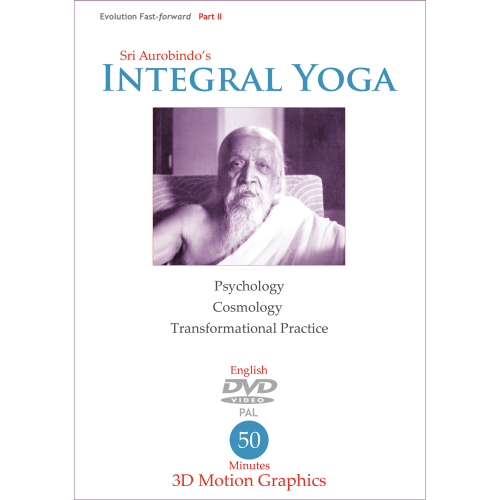
Broad overview of psychology, cosmology and transformational practice of Integral Yoga – a psychological and spiritual methodology for evolutionary transformation of human nature developed by Sri Aurobindo. In 3D motion graphics.
Man is a transitional being…
A psychological and spiritual methodology for evolutionary transformation of human nature.
Psychology
We mean by psychology the study of the psyche (ψυχή) following yogic methodology. It is different from the academic and applied discipline of psychology as it emerged in the West over the last 100 years, involving the scientific study of mental functions and behaviors. The fundamental difference in methodology also leads to very different orientations, discoveries and consequences.
Cosmology
We are presenting here not the cosmology of the physicists but the cosmology as mapped by Sri Aurobindo following the methodology of Integral Yoga. In this view, consciousness is the most fundamental thing in existence and the exploration covers the full spectrum of consciousness and its evolutionary process.
Transformational Practice
Integral Yoga is a methodology Sri Aurobindo developed for not only exploring the profound depths and heights of human psyche but also for an integral evolutionary transformation of the human nature. Here we give a broad overview of the process leading towards psychic, spiritual and supramental transformation.
The Word in the Rig-Veda
and in Sri Aurobindo’sepic poem Savitri
by Nishtha Müller
The inspired poetic Word was the means of passing on knowledge and experience by the VedicSeers and by Sri Aurobindo, especially in his epic Savitri. What do the Vedic seers and SriAurobindo in their poetic creations themselves tell us about the Word, its nature and usage?
At the outset it must be said that this study is not exhaustive and does not intend to cover all relevant passages either from the Veda or from Savitri. Its central idea is simply to make potential readers more conscious of the great value of these mantric texts and point out a possible way to approach these divine gifts to aspiring humanity. In regard to the Veda it must be said right from the outset that there exists the special barrier of the Sanskrit language in general and the multi-layer meaning of Vedic terms in particular.[1] In addition there is the all-pervasive Vedic symbolism. Sri Aurobindo often calls the Vedic Rishis “symbologists” and refers back to the period of the composition of the Vedic hymns both as the age of symbolism and the age of intuition. In fact Sri Aurobindo also makes much use of symbolism. In this study we will see that the Veda and Savitri shed light on each other in their symbolism.
But let us first ask the general question: what do the Veda and Savitri have in common? They are both mystic mantric poetry of the highest order. Sri Aurobindo refers to the Veda – certainly among Indian literature and scriptures, and perhaps even beyond – as “our supreme poetry”[2] They both bring forth an integral vision of reality and transmit it as revelatory knowledge and verifiable experience (and that does not exhaust the subject.)
What is the basic difference between them? Savitri, in its outer form, is one single epic poem written by one sole author, whereas the Rig-Veda consists of a collection (samhita) of more than one thousand hymns (suktas, meaning perfect utterances) of many different seers, spanning a time of at least several centuries. Even though some of the Suktas are made up of a considerable number of verses or stanzas they generally do not reach the length of any of the cantos which we find in the twelve books of Savitri. From that point of view one could say, with a few exceptions, that the Vedic hymns are even more concise than any paragraph in Savitri. Still, all Vedic hymns presume a common background, and many of them are related to the same theme but present it from different standpoints, a practice which we also find within the different books of Savitri.
It is a known fact that Sri Aurobindo in Savitri makes abundant use of Vedic imagery as the carrier of his knowledge and experience. It might be worthwhile to remember in this context that in the period from 1912 up to perhaps 1920 Sri Aurobindo was studying and writing on the Veda on an almost daily basis, and also translated hundreds of its hymns into English. Among other reasons, it could have as well been due to this preoccupation with the Book of Mantra (the traditional name given to the Veda) that Sri Aurobindo conceived the idea to do something of the kind – even though in a different form – for the present age in the much more easily accessible English language. At the same time we should not forget the fact that already before this period Sri Aurobindo was an accomplished poet and seer. But, knowing on one hand how central is the usage (and its constant mentioning in hymn after hymn) of the inspired Word to the Vedic seers, and on the other hand how much and in detail Sri Aurobindo writes about this fact in “The Secret of the Veda”[3], one could still dare the thought that it might have inspired him to do something similar.
https://auro-ebooks.com/wp-content/uploads/2015/03/light-288x288.jpg288288Website Visitorhttp://auro-ebooks.com/wp-content/uploads/2023/06/auro-ebooks-logo.pngWebsite Visitor2015-03-24 16:19:262026-08-09 13:01:07The Word in the Rig-Veda and in Sri Aurobindo’s epic poem Savitri
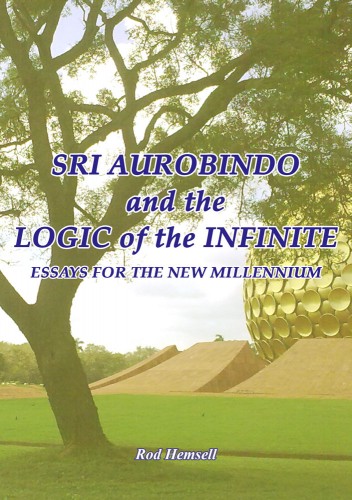
About this book, the author, Rod Hemsell says, “Most of these essays were collected in 2003, a few recent ones have been added to this edition in the sections on philosophy and mantra, but obviously the earliest already contain the same basic insights that underlie the more systematic studies that I have done since 2008, after reading Sri Aurobindo for forty years.”
On the cover of the first edition, Georges Van Vrekhem wrote, “Not only are there in the essays which constitute this volume the philosophical landscapes the author has been and continues exploring, there is also the testimony of his practical commitment to the realization of a better world. As Sri Aurobindo wrote, the whirlpool of the present globalisation may well be the disorienting transition to the unity of humanity, necessary for the realization of the next step in evolution. After all, if evolution is a fact, why would it stop at the human species? It is in this perspective that Auroville, the City of Dawn, the most daring utopia of them all, has to be seen, and it is to the working out of this ideal that Rod Hemsell is contributing with his life. This is a thinker who dares to walk on the roads of infinity and find on them his fulfilment.”
https://auro-ebooks.com/wp-content/uploads/2014/12/logic-of-the-infinite-a5-cover250sq.png250250Auro e-Bookshttp://auro-ebooks.com/wp-content/uploads/2023/06/auro-ebooks-logo.pngAuro e-Books2014-12-02 16:13:242026-08-26 03:53:58Sri Aurobindo and the Logic of the Infinite
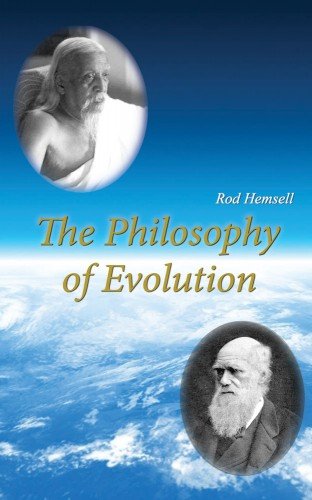
As presented here, The Philosophy of Evolution, is a compendium of lectures presented by Rod Hemsell at the University of Human Unity in Auroville in 2008, 2009 and 2012. The main thrust of Sri Aurobindo’s yoga has always been toward an active participation in the human evolution and this is the defining concept which set Sri Aurobindo and the Mother apart from all others in the very beginning. With his extensive knowledge of philosophy and numerous philosophers and his familiarity with current science, Rod is able to guide the reader through the development of thought in these disciplines and shows us the place that Sri Aurobindo has staked out for us as the enlightened forerunner he was. These lectures are not a difficult or tedious ascent to airless heights, rather, they are instructive explorations of the broader base camps surrounding the mount; it is left to Sri Aurobindo and the Mother to guide us in our ascent. However, with this exploration of the terra firma, we become ever more confident that our guides to the snow capped peaks actually do know whereof they speak.
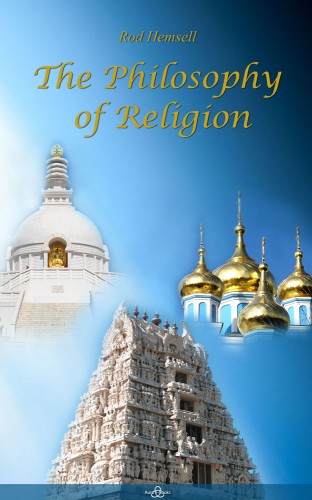
The material in this book is a transcription of a series of twelve lectures presented by Rod Hemsell at Savitri Bhavan in Auroville, India. With broad brush strokes highlighted with interesting and intricate detail, Rod paints a rich historical portrait illustrating the evolution of philosophical thought and its impact on religious doctrine which extends over a twenty-four hundred year span. The underlying theme, of course, is the slow and steady evolution of human consciousness flowing along many separate streams of thought springing forth from the fount of human experience while growing in knowledge. The depth of this discourse is not at all overwhelming; however, we are no longer wading in the kiddie pool here. In these lectures, Rod has introduced a number of familiar characters and ideas and he has also introduced several others who may not be so well known, all of which invites the reader to follow up with investigations of their own. Rod’s treks along ancient pathways draw us along to discover the great, underlying similarities between the major religions of today that might otherwise go unnoticed and he convinces us that such was always inevitable since we have been dealing with universal truths all along.