
Overman
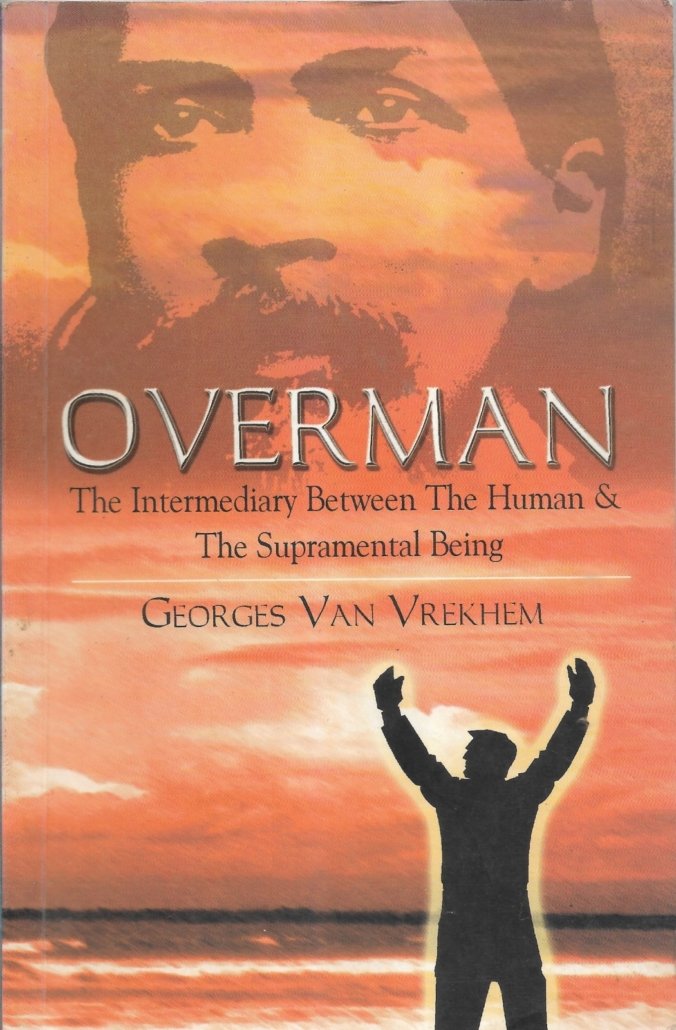
Overman:
The Intermediary between the Human and the Supramental Being
Sri Aurobindo and the Mother wrote and spoke at a time before the awareness of “gender specific language”. Yet, they more than anybody else stood for the importance and dignity of the individual in all its aspects, male and female. For those who are not familiar with their personalities and their work, it may suffice to say that they admitted in their Ashram sadhaks and sadhikas on an equal footing at a time when this was most unusual.
When writing on subjects in connection with Sri Aurobindo and the Mother it is not always possible, however hard one tries, to adapt one’s language to the present sensibilities.
The book before you offers an important new presentation of an aspect of Sri Aurobindo and the Mother ’s vision and yogic development. The Mother ’s French term surhomme, meaning the intermediary between the human and the supramental being, has until now been wrongly translated as “superman”, the word which in Sri Aurobindo and the Mother’s work stands throughout for the supramental being. To end this confusion and to clearly indicate the place the intermediary being occupies in the ongoing evolution beyond humankind, I find it essential to translate surhomme as “overman”.
“We start from the idea that humanity is moving to a great change of its life which will even lead to a new life of the race, – in all countries where men think, there is now in various forms that idea and that hope, – and our aim has been to search for the spiritual, religious and other truth which can enlighten and guide the race in this movement and endeavour. …”
“As man arose out of animal, so out of man superman shall come,” said Sri Aurobindo. Overman is a metaphysical book which dwells upon the concept of the ultimate progression of man into a highly enlightened species called the supramental being, towards which, the author says, the intermediary stage (the Overman) has already been reached.
Book Details
Author: Georges Van Vrekhem
Print Length: 202 pages
Publisher: Rupa (2001) — no Dutch translation
Copyright: Georges Van Vrekhem
Language: English
Book Download
Contents
- Author’s Note
- 1. An Encounter in Sleepy Pondicherry
- 2. Four Pillars
- 3. Turning Towards the Earth
- 4. A First Sketch of Supermanhood
- 5. Overman
- 6. The Consciousness of the Overman
- Note About the Sources
- Biographical Note
Sample
Overman:
The Intermediary between the Human
and the Supramental Being
1. An Encounter in Sleepy Pondicherry
And Thy reign shall be indeed established upon earth[1]
– the Mother
On 29 March 1914, a Parisian lady in Pondicherry went around 3 p.m. from the Hôtel d’Europe in the Rue Suffren to no. 41 Rue François Martin. She was Madame Mirra Richard and she had arrived with her husband, Paul, in the sleepy colonial port that very morning. The Richards had boarded the Japanese ship Kagu Maru in Marseilles three weeks earlier, sailed through the Suez Canal up to Colombo, crossed the Palk Strait, boarded the Boat Mail at Danushkodi and arrived safely at their exotic destination.
Paul Richard was a philosopher and a politician. He had first come to Pondicherry four years earlier in order to support a local candidate during the elections for the Chamber of Deputies in Paris. As a French territory, Pondicherry was entitled to two representatives. Richard, however, was also deeply interested in occultism and religion, and his main reason for having travelled to the South Indian town may well have been that he wanted to meet an Indian yogi. In this he had been extraordinarily lucky, for Aurobindo Ghose, the well-known freedom fighter turned yogi, had just arrived in Pondicherry, looking for a safe haven from the British authorities who wanted to arrest him, “the most dangerous man in India”, at any cost. Richard had been deeply impressed by Aurobindo Ghose and had told his wife about him. The reason she accompanied Richard on his second visit to Pondicherry may well have been that he wished her to meet Aurobindo Ghose. Richard’s aim was to get himself elected as a Deputy, but in this he would not succeed.
It would be an exaggeration to say that Mirra had been enthusiastic about undertaking the voyage. On 3 March 1914 she wrote in her diary: “As the day of departure draws near, I enter into a kind of self-communion; I turn with a fond solemnity towards all those thousand little nothings around us which have silently, for so many years, played their role of faithful friends: I thank them gratefully for all the charm they were able to give to the outer side of our life”. This suggests that they planned to stay abroad for a long time. “Then I turn towards the future and my gaze becomes more solemn still. What it holds in store for us I do not know nor do I care to know.”[2] After his first visit to Pondicherry, Paul Richard had brought back a photograph of Aurobindo Ghose and she, despite her advanced occult capacities, had seen only the politician in him.
Therefore, while walking the mile or so from her hotel to the house where Ghose was living with a few companions, all of them Bengali revolutionaries, Madame Richard perhaps had mixed expectations. Paul had already gone out to greet Aurobindo Ghose immediately upon their arrival in the morning; on the occasion of her first meeting with the unknown Indian, Mirra had wanted to see him alone. Expecting nothing, she had nevertheless prepared everything – as we know from her later conversations – and may have been mulling over some thoroughly considered questions in her mind.
There she stood, then, at the bottom of the staircase leading to the first floor, where Aurobindo Ghose was living – and there he stood, at the top: “Exactly my vision! Dressed in the same way, in the same position, in profile, his head held high. He turned his head towards me and I saw in his eyes that it was He.”[3] For many years Mirra had been visited and guided in her dreams by several masters, one of whom she named Krishna. This “Krishna” always appeared to her in a dress which she, at the time unfamiliar with the Indian dhoti, could not identify and which she therefore thought to be a “costume worn in visions”. Now he stood there before her in the flesh, embodied on earth: Aurobindo Ghose.
The significance of the moment became immediately apparent to her, and we read in her diary entry of the next day: “It matters little that there are thousands of beings plunged in the densest ignorance. He whom we saw yesterday is on earth; his presence is enough to prove that a day will come when darkness shall be transformed into light, and Thy reign shall indeed be established upon earth.”[4] (“Thy” and “Thou” refer to the Lord, the Divine to whom the diary entries are addressed.) A night had elapsed between the meeting and the entry in her diary, and things were now seen in a certain perspective: “In the presence of those who are integrally Thy servitors, those who have attained the perfect consciousness of Thy presence [in this case Aurobindo Ghose], I become aware that I am still far, very far from what I yearn to realise; and I know that the highest I can conceive, the noblest and purest is still dark and ignorant beside what I should conceive. But this perception, far from being depressing stimulates and strengthens the aspiration, the energy, the will to triumph over the obstacles so as to be at last identified with Thy law and Thy work.”[5]
The importance of the encounter is also obvious from the following entries in her diary. 1 April 1914: “I feel we have entered the very heart of Thy sanctuary and grown aware of Thy very will. A great joy, a deep peace reigns in me, and yet all my inner [mental] constructions have vanished like a vain dream and I find myself now, before Thy immensity, without a frame or system, like a being not yet individualised. All the past in its external forms seems ridiculously arbitrary to me, and yet I know it was useful in its own time. But now all is changed: a new stage has begun.”[6] 3 April: “It seems to me that I am being born into a new life and all the methods, the habits of the past can no longer be of any use. It seems to me that what I thought were results are nothing more than a preparation. I feel as though I have done nothing yet, as though I have not lived the spiritual life, only entered the path that leads to it, it seems to me that I know nothing, that I am incapable of formulating anything, that all experience is yet to begin …” [7]
And on 14 June Mirra wrote: “It is a veritable work of creation we have to do: to create activities, new modes of being so that this Force, unknown on earth till today, may manifest in its plenitude. To this work I am consecrated, O Lord, for this is what Thou wantest of me. But since Thou hast appointed me for this work, Thou must give me the means, that is, the knowledge necessary for its realisation … Thou hast made a promise, Thou hast sent into these worlds those who can and that which can fulfil this promise. This now demands Thy integral help so that what has been promised may be realised. In us must take place the union of the two wills and two currents, so that from their contact may spring forth the illuminating spark. And since this must be done, this will be done.”[8]
These are mysterious words which this book will have to explain. Which new modes of being were to be created? What promise was made to her by “the Lord” Himself? What was that something new that had to be realised? Radical words too, charged with a will to confront all obstacles and aware of the beginning of a new epoch in the history of humanity.
…